0+
Schools
0
Presentations
0+
Students
Student Workshops
Are You Going to Eat That? Food, Politics, and Race in America.
This workshop will explore American life through our favorite foods and attitudes toward them, with a particular emphasis on regional identities. Examining such identities allows us to probe the socio-political contexts that make American patterns of eating and dining, especially among teenagers, emblematic of the systemic inequities that challenge many demographic groups across the country. Images, video clips, and essential questions about food and identity will drive our conversation about whether there is such a thing as “American Food.” Extend the lesson: supplemental texts include non-fiction excerpts and memoirs that prompt students to think about their own relationship to food and identity.
This workshop can be adapted for up to 50 students and can take 45, 60, or 90 minutes.
Adolescent Ambition in America: When Striving for Success Feels Insurmountable.
American high school students are under immense pressure to succeed, which often means going to the right college and choosing the best professional path. This workshop is framed by F. Scott Fitzgerald’s seminal novel, The Great Gatsby, a book many see as the epitome of American ambition. From there, our conversation will consider the implicit and explicit iterations of “the American Dream” from an American perspective and question whether the Dream is still alive and if it is American at all. Recent polling data and a view into the college application process will support our dialogue and help us determine whether there really is such a thing as a “self-made man,” that most American concept of success. Extend the lesson: supplemental materials include American short stories and non-fiction excerpts.
This workshop is suitable for groups of up to 40 students. It works for 45, 60, or 90-minute classes.
The Immigrant and the Outsider in New York City.

This workshop will examine the immigrant experience through the lens of place, New York City, and through my perspective as a native New Yorker and daughter of a father whose first language was not English. His working life was spent in one of NYC’s biggest trade unions, Local 15 of the International Union of Operating Engineers. From literally building the bridges and highways that connect the five boroughs to digging up bodies in the rubble after the attacks on 9-11, his experience provides a framework for this workshop that examines stories of the immigrant and the outsider in the city that never sleeps.
This workshop is suitable for groups of up to 40 students and will work best in a 45 or 60-minute lesson.
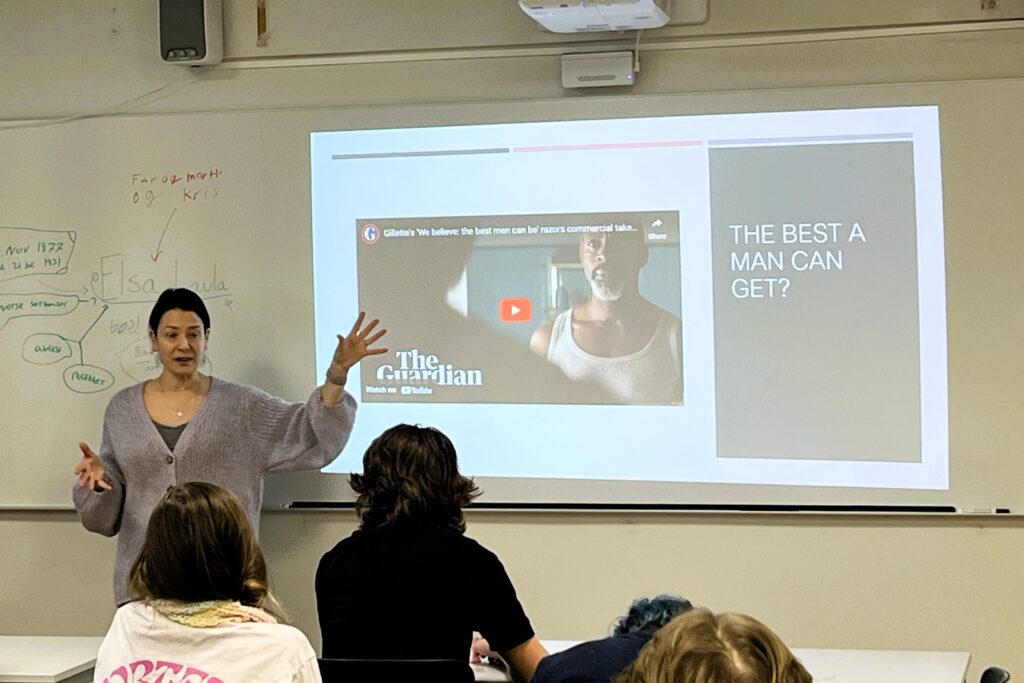
The Best a Man Can Get?: Adolescence and Masculinity in America.
Considered one of America’s most masculine writers, Ernest Hemingway casts a long shadow over the twentieth century. Framed with an introduction to popular misconceptions about the man and the myth of Hemingway, this workshop will use excerpts from pop culture to examine American notions of masculinity, toughness, and individualism that have developed in the wake of Hemingway’s cultural legacy. How has the spirit of Hemingway’s toughness underscored American ideas of individualism and resilience? How do guns factor into all of this? How does it infect or inform our politics? Students will take part in a gender thought exercise that asks them to consider their own biases in regard to gender roles. Extend the lesson: supplemental readings include non-fiction and fiction excerpts.
This workshop is best for groups of up to 30 students and for 60 minutes.
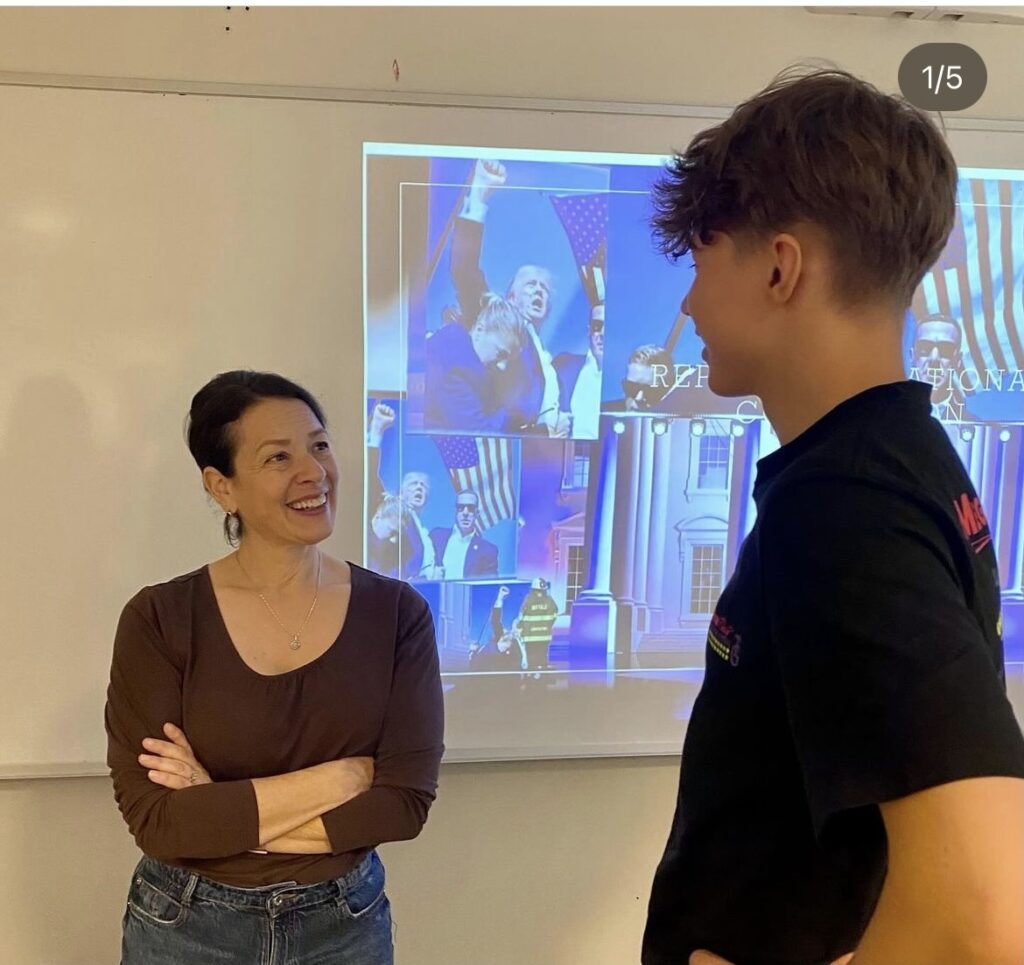
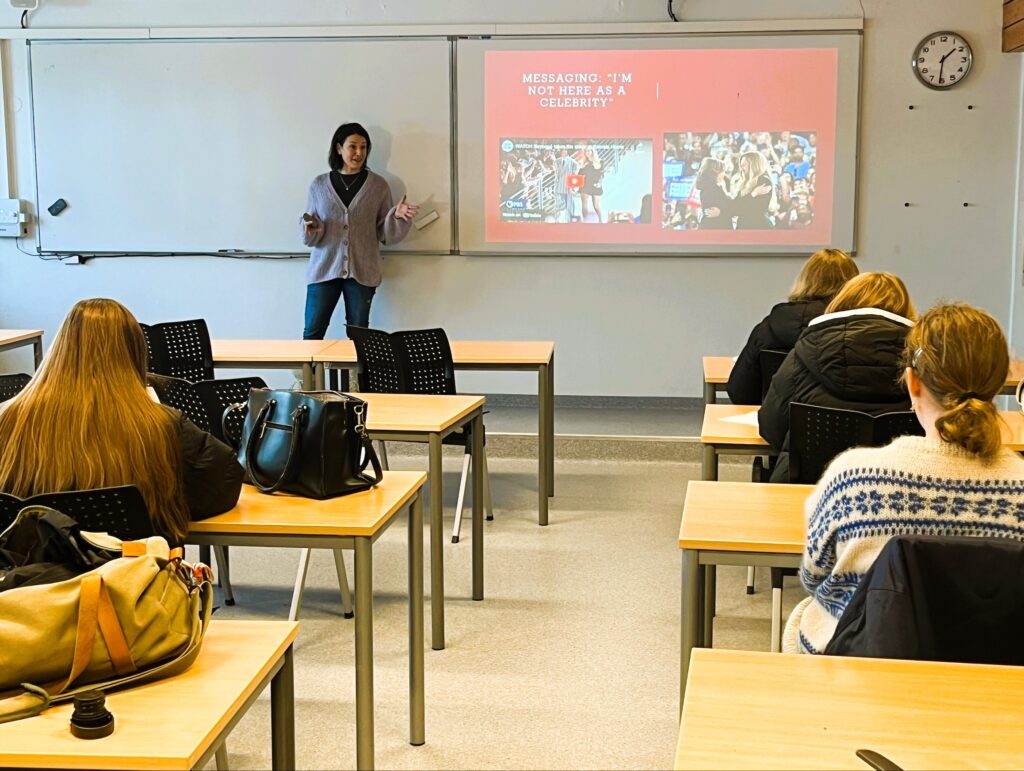
“‘Murica!”: Election Aftermath Special—Studying Sound Bites and Loaded Words in the American Media.
Designed to coincide with the aftermath of our last presidential election, this workshop looks at rallying cries from across the political spectrum and especially the use of loaded words, a rhetorical strategy designed to take advantage of socio-political contexts and to amplify incendiary responses. The effect of such phrases lies in their distillation of powerful social sentiment, and students’ understanding of them depends upon critical thinking skills that synthesize information from different contexts. Students will be tasked with creating or finding Norwegian examples of their own single word or phrase that operates along similar rhetorical lines.
This workshop can be amended for smaller or larger groups and classes up to 90 minutes.
What’s so funny? Humor and Cultural Belonging in America.
The principle of gaining trust vis-à-vis cultural and linguistic fluency is particularly relevant given the circumstances surrounding a Roving Scholar. This workshop grows out of my own curiosity about Norwegian culture, humor, and language. In exchange for as many jokes as my Norwegian hosts are willing to offer, I hope to reciprocate anecdotally and also by demonstrating how some of America’s funniest writers are also our darkest prophets, challenging assumptions about the monolith of American optimism.
This workshop asks students to write and discuss, requires an open mind, and is best suited for groups of no more than 15 – 20 students who are comfortable with each other. It is also best suited for shorter periods of 45 – 60 minutes.
Dealer’s Choice: Education, Healthcare, or Literature
You Have Questions? I (Might) Have Answers! In response to hundreds of questions from students and teachers over the past four months of being a Roving Scholar, I’m offering this “choose your own adventure” workshop. Do you want to focus on literature? With advance notice, I can send an American text for students to prepare that we will discuss. Are your students more interested in the American education or healthcare system? We can tackle one or the other of those issues in turn. This workshop is truly inquiry-based, which means that what you bring to it will be the measure of what you get out of it.
This workshop is best suited for groups of up to 40 students and is limited to 60 minutes.
Teacher Workshops
E Pluribus Unum: Teaching the Short Story Cycle as American Metaphor.
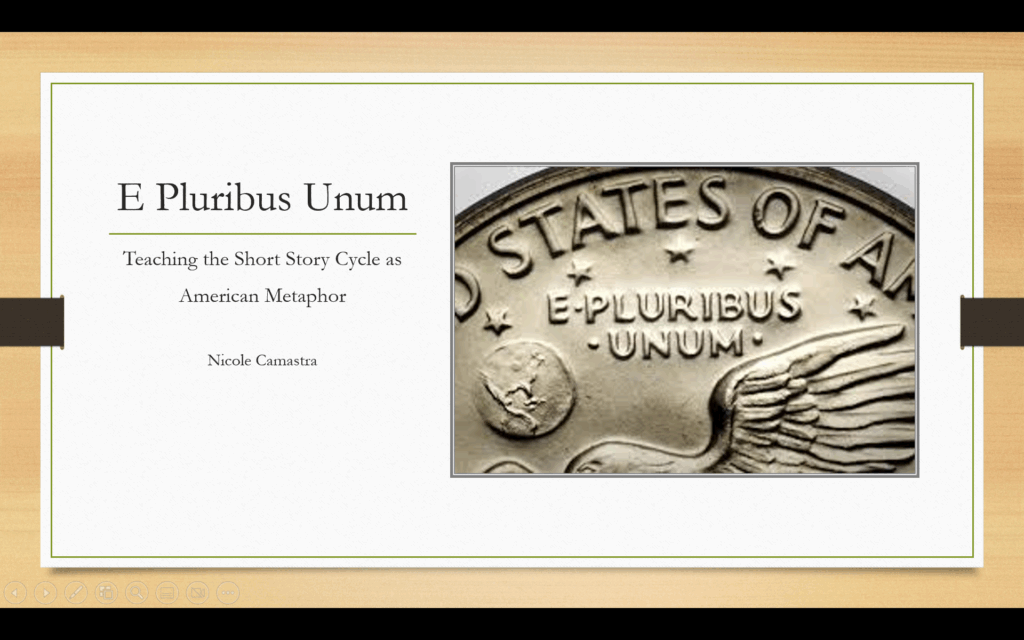
The Latin phrase on American coinage, e pluribus unum, means, “out of many, one,” and its use in Colonial America signified the unity that grew from the disparate thirteen colonies. The notion of “one from many” also defines short story collections; the texts contained within them are simultaneously independent and interdependent. This tension between unity and fracture defines the genre and helps explain why many see it as central to the American literary tradition. This workshop is designed to help teachers use the story cycle in two ways: to meet the curricular objective of reading and understanding works of fiction in English as well as to introduce their students to core ideas about American identity and experience.
This workshop is designed for either a 45- or 60-minute session.
Citing, Syntax, and Phrasing, Oh My!: Tackling Three Intimidating Components of Writing.
Teaching writing and research skills can often be daunting for the sheer reason of not knowing where to start. This workshop provides teachers with practical resources and strategies for guiding students in three elements of the compositional process: 1) finding, evaluating, and selecting source material; 2) helping students develop their own sentence-level style; and 3) incorporating grammar instruction into writing and/or reading practice.
This workshop can be broken up to focus on only one of the three elements or can cover all three. As such, it can expand or contract, to accommodate 45-, 60-, and 90-minute sessions.
The Medium and the Message: Teaching Writing and Research in the Digital Age.
Technology gives students the illusion of productivity, but it doesn’t necessarily make their writing better. Students often lack the confidence to realize this. Comprised of two major parts, this workshop will provide 1) a framework and tools for working alongside AI in the classroom, including inquiry-based approaches to composition that help offset the temptation of AI by feeding curiosity; and 2) practical tips for helping students improve their writing on the sentence level so that, maybe, they will prefer their prose to that of Chat GPT. This workshop does not pretend to have the answers to all the questions about AI or Ed Tech, but it will provide some actionable steps teachers can take to start considering how and why they teach writing.
This workshop is designed to last 45 – 60 minutes.
Emotional Audits as Empowerment Strategy.
Students are experiencing more anxiety and depression than ever before. We forget that emotions happen at school, and our older students are often at a greater disadvantage than their younger counterparts because they are expected to navigate those emotions on their own so that the academic work gets done. This workshop focuses on my adapted use of emotional audits to help students discover and name the constellation of values that imbues their school lives. Doing so empowers them to process experiences at school and to move through the work in front of them with a sense of agency and autonomy.
This workshop takes at least 60 – 90 minutes and is best suited for colleagues who are very comfortable with each other.